Why Denim-Look Leggings Cling in Dry Air - and the Fixes That Actually Last
Quick Answer: Static happens because synthetic fibers exchange electrons on contact and dry air will not let the charge dissipate. Denim-look leggings are worse than plain ones because the coating or print raises the surface synthetic content. The fixes that last: raise indoor humidity to 40-50%, skip the dryer or use wool dryer balls, and wear a natural-fiber base or a lining layer to break the synthetic-on-synthetic contact. Dryer sheets work for one wear; humidity works all season.
It is one of the more annoying autumn wardrobe problems, and it always arrives within a week of the heating going on for the first time.
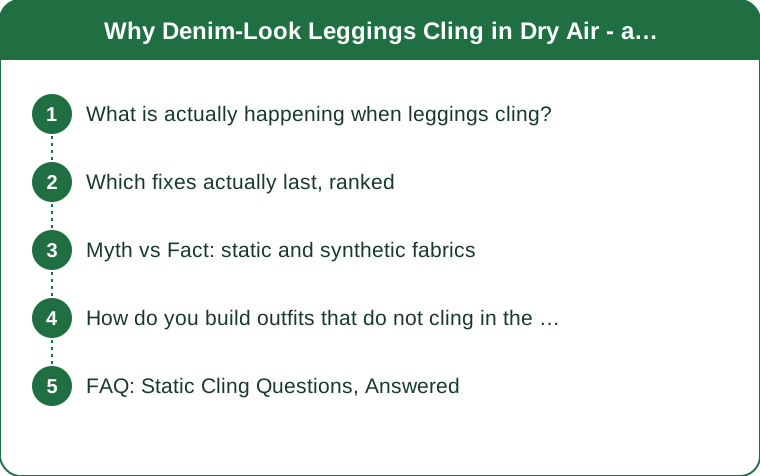
What is actually happening when leggings cling?
Two materials rubbing together exchange electrons, leaving one positively charged and the other negatively. This happens constantly, all year. What changes seasonally is whether the charge can escape.
Water is conductive. In humid air, a thin layer of moisture on fabric surfaces lets accumulated charge bleed away continuously, and you never notice it. When indoor humidity drops - and heated indoor air in winter routinely falls to 15-25% - there is no path for the charge to leave. It builds until something discharges, usually your skirt against your legs or a spark at a doorknob.
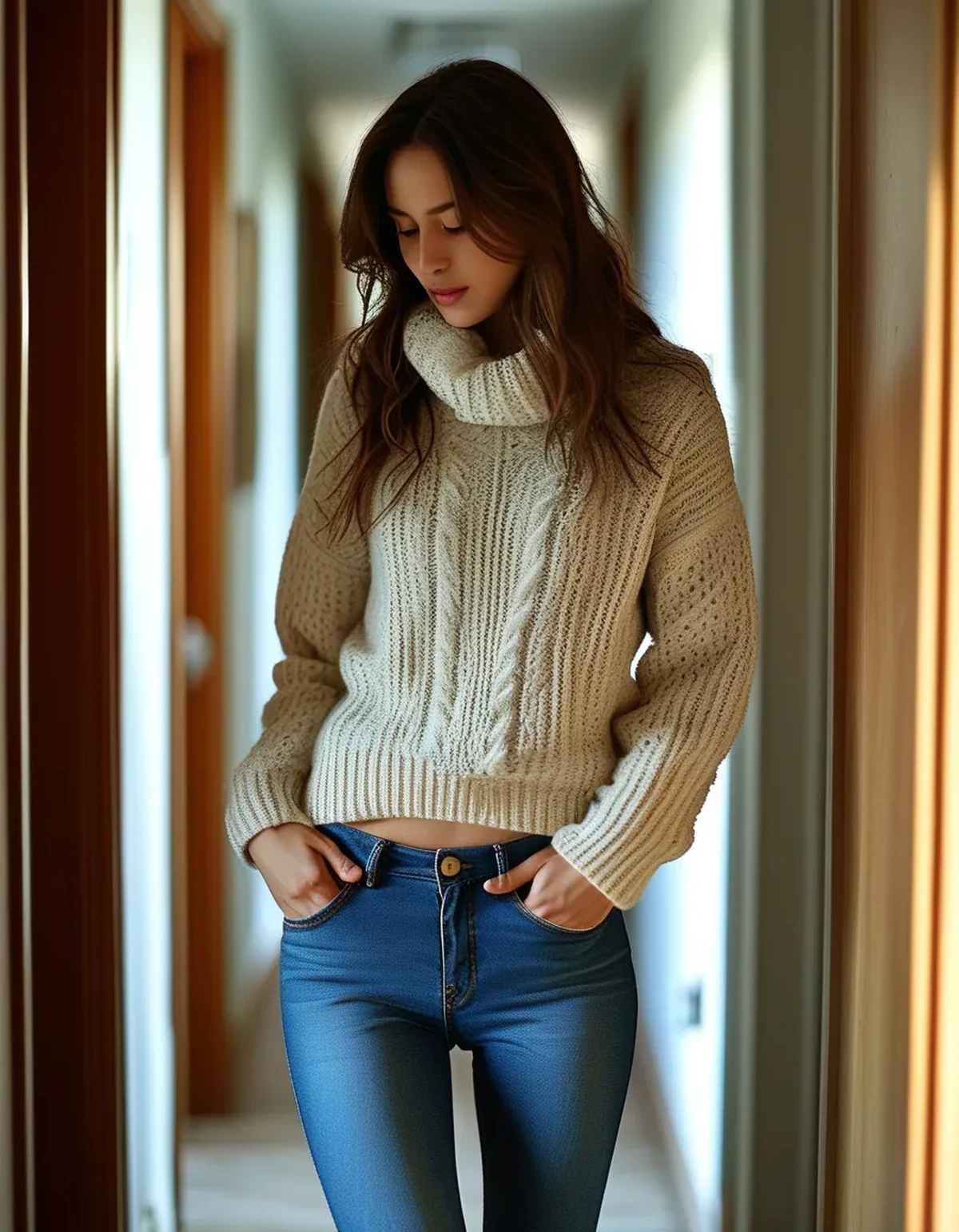
Why denim-look leggings specifically are worse: most rely on a printed or coated surface to create the denim texture and color. That surface treatment is typically polyurethane-based or a high-synthetic print layer, and it increases the proportion of the outer surface that is aggressively synthetic. More synthetic surface, more charge separation on contact.
The materials at the extremes of the triboelectric series - the ranking of which materials give up electrons and which grab them - generate the strongest charges when paired. Polyester or nylon against wool or acrylic is one of the worst pairings, which is exactly the sweater-over-leggings combination the season demands.
So it is not that the leggings are cheap or worn out. It is a predictable materials interaction in dry air.
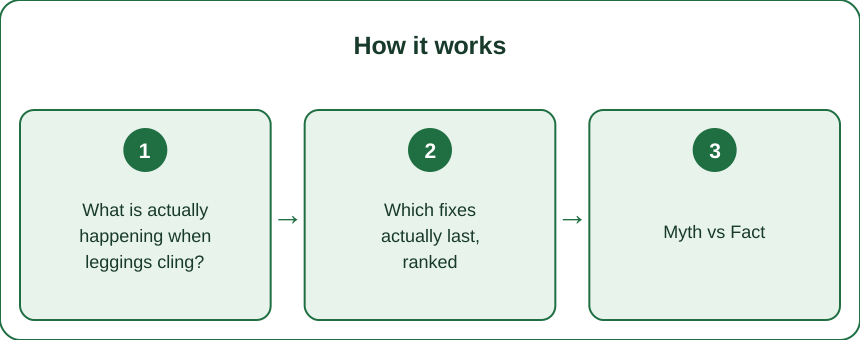
Which fixes actually last, ranked
Longest lasting: raise the humidity. A humidifier keeping indoor air at 40-50% eliminates most static at the source and helps skin, sinuses, and wood furniture too. This is the only fix that works continuously without maintenance. One unit in the bedroom running overnight makes a noticeable difference to how the whole next day goes.
Lasts weeks: change how you dry them. Tumble drying is a static generation machine - it is friction between synthetics in a dry heated drum. Line drying eliminates the problem entirely and is better for the elastane anyway. If you must tumble dry, wool dryer balls reduce static meaningfully and last for hundreds of loads. Also: do not over-dry. Fabric pulled out slightly damp has far less static than fabric run an extra fifteen minutes.
Lasts one wear: the day-of fixes.
- A dryer sheet run over the inside of the leggings and the inside of your sweater.
- A light mist of water on the lining of your top layer.
- Unscented hairspray on the inside of a skirt or dress, not on the leggings.
- Lotion on your legs before dressing - dry skin holds charge and hydrated skin does not.
Instant but temporary: touching a metal doorframe or a metal railing discharges you and does nothing for the fabric.
Does not work despite being widely repeated: safety pins in the hem. The physics do not support it in ordinary clothing.

Myth vs Fact: static and synthetic fabrics
Myth: Static means the leggings are cheap or poor quality. Fact: static is a materials and humidity interaction. A premium coated legging generates static as readily as a budget one, sometimes more if the coating is more complete. It says nothing about durability or construction.
Myth: Fabric softener is the best solution. Fact: it works, and it comes with a real cost for activewear. Liquid softener coats fibers, which reduces moisture wicking and, over time, degrades elastane recovery. On a legging you actually train in, softener is a bad trade. Wool dryer balls achieve most of the same effect without coating the fibers.
Myth: Natural fibers never generate static. Fact: wool absolutely does - it is at the far positive end of the triboelectric series. What natural fibers do better is hold moisture, which lets charge dissipate. Cotton in a humid room is essentially static-free; cotton in 15% humidity is not.
Myth: Washing more often reduces static. Fact: it usually increases it, because most static is generated in the dryer. If you are washing after every wear and tumble drying, you are running the static machine more often, not less.
Myth: Anti-static sprays are just water. Fact: they contain surfactants that leave a mildly conductive residue, which genuinely works. You can approximate one with a few drops of fabric softener in a spray bottle of water, misted on the inside of a top layer rather than on the legging itself.
How do you build outfits that do not cling in the first place?
Static is a contact problem, so the answer is what touches what.
Break synthetic-on-synthetic contact with a natural layer. A cotton or bamboo base layer between a wool sweater and a synthetic legging removes the worst pairing. A cotton slip under a skirt does the same job for the classic clinging-skirt problem.
Choose your top layer with the pairing in mind. A cotton or cotton-blend sweater over synthetic leggings generates far less charge than acrylic or wool over the same leggings. If you own one problem sweater that clings every time, it is probably acrylic.
Watch the coat lining. Many coat linings are polyester, and a full day of a lining rubbing against leggings is a lot of contact time. A coat with a cotton or viscose lining behaves noticeably better.
Boots matter too. Synthetic boot linings against a legging inside a boot shaft is a friction zone people never think about, and it is why static often feels worst at the calf.
Footwear grounding: leather-soled shoes let charge dissipate to the floor; rubber soles insulate you completely. This is a real effect and a minor one compared to humidity, but it explains why the same outfit behaves differently with different shoes.
Wash and store thoughtfully: turn leggings inside out to protect the printed surface, wash cold, and hang dry. The print or coating is the part that degrades first, and heat is what degrades it.
FAQ: Static Cling Questions, Answered
Will static damage the leggings?
The discharge itself does not. What damages coated and printed leggings is heat from tumble drying, which is also the main static source - so the fix for one is the fix for the other.
Why does it only happen with certain sweaters?
Because the pairing matters more than either item alone. Acrylic and wool sit far from polyester on the triboelectric series, which produces the strongest charge. A cotton sweater over the same leggings often produces almost none.
Does the humidity fix work fast enough to matter?
A humidifier changes a bedroom’s humidity within an hour or two. Whole-home levels take longer. Most people notice a difference in the first day or two, particularly in the morning after running it overnight.
Is there anything to do at work when it starts mid-day?
Hand lotion on your legs through the ankle if you can reach, or a quick pass of a damp paper towel over the inside of your top layer. Both are temporary but both work within seconds.
TL;DR:
- Static is charge that cannot escape in dry air, and coated denim-look leggings raise the synthetic surface area.
- The lasting fix is humidity at 40-50%; the second best is line drying or wool dryer balls.
- Break the contact with a natural-fiber layer, and check your sweater - acrylic is usually the culprit.
- Skip liquid fabric softener on activewear; it coats the fibers and hurts recovery.
Run a humidifier, stop tumble drying, and the problem mostly disappears for the season - along with the doorknob shocks.
See It in Motion
Seen here: High Waist 8” Yoga Shorts — shop similar styles on bubblelime.com
Keep Reading
This article is for general informational and styling purposes only. Fit, sizing, and product availability may vary.
