Why Denim Look Leggings Photograph Differently Than They Look in Person
Quick Answer: In person, your eye reads denim through micro-shadow and depth as you move. A camera flattens that into a single two-dimensional pattern, so a printed denim texture that convinces in the room can read as a flat pattern in a photo. Flash makes it worse by killing the shadow entirely and lighting the print’s sheen. Choose textured or embossed constructions over flat prints, avoid direct flash, and shoot in soft directional daylight if you want them to photograph the way they look.
The mirror says jeans. The photo your friend sent says leggings printed to look like jeans.
Both are accurate, which is the interesting part.

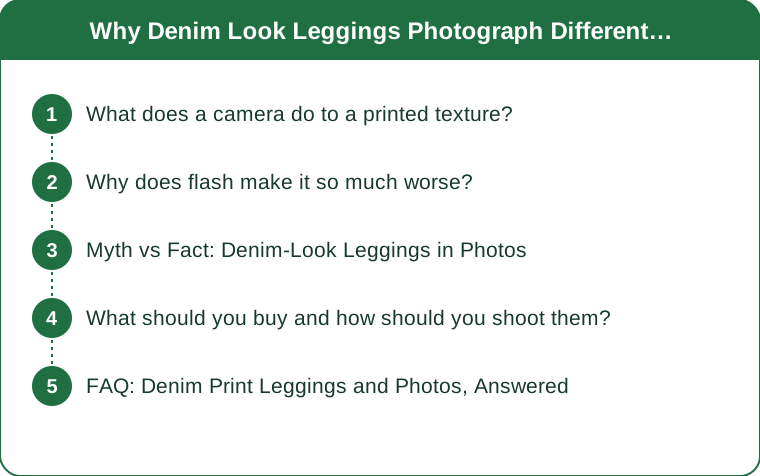
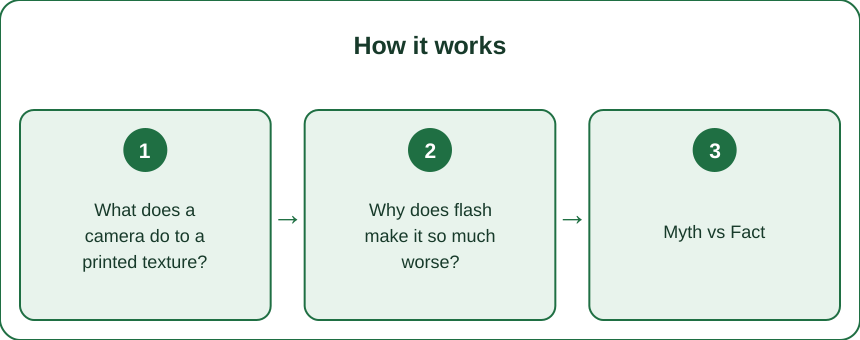
What does a camera do to a printed texture?
Real denim reads as texture because of tiny shadows. The twill weave creates a surface of raised and recessed threads, and your eye interprets the pattern of micro-shadows as depth. That interpretation happens continuously as light and viewing angle shift.
A print has no shadows of its own. A printed denim effect reproduces the colour pattern of denim without reproducing the surface geometry, so there is nothing to cast the shadows the eye is looking for.
In person, movement compensates. As you walk, the light angle changes constantly, and the fabric’s drape and stretch produce shadow and highlight that your brain reads as convincing enough.
A photo removes movement entirely. One frame, one light angle, no motion cue. Everything your perception was using to fill in the depth is gone, and what remains is the flat pattern.
Cameras also apply processing that flattens further. Phone cameras raise contrast, sharpen edges, and reduce noise, and noise reduction in particular smooths exactly the fine tonal variation that makes fabric look like fabric.
Which is why the effect is not your imagination. The garment did not change between the mirror and the photograph. The information available to interpret it did.
Why does flash make it so much worse?
Direct flash eliminates shadow. A light source at the same position as the lens fills in every recess, and shadow is exactly what was creating the impression of texture. Flash photographs of textured fabrics reliably look flat.
It also lights the print’s sheen. Printed and coated fabrics usually have a slightly different surface finish from woven cotton, and a direct light source reveals that as an even sheen across the whole leg - something real denim does not do.
It exaggerates stretch distortion. Where the fabric is stretched over the knee or thigh, the print stretches with it, and hard light emphasises the resulting distortion in the pattern.
Overhead lighting is a similar problem. Restaurant and bar lighting from directly above creates strong top-down highlights and few side shadows, which is why night-out photos are often where the print gives itself away.
Soft directional light is the flattering opposite. Window light from the side, or overcast outdoor light, creates gentle shadow that lets the fabric read as dimensional again.
And distance matters. At a normal conversational distance the print reads fine even in a photo. Close-up shots of the thigh or knee are where the pattern’s flatness becomes obvious.

Myth vs Fact: Denim-Look Leggings in Photos
Myth: If they photograph badly, they look bad in person. Fact: these are different perceptual situations. In-person viewing has motion, binocular depth, and changing light angles, none of which a photo has.
Myth: More expensive versions always photograph better. Fact: what matters is construction, not price. An embossed or textured fabric photographs better than a flat print at any price point.
Myth: The colour is what gives them away. Fact: colour is usually the most accurate part. It is the absence of surface texture, and the even sheen under hard light, that reads as printed.
Myth: Editing can fix it. Fact: adding contrast can help slightly, but you cannot add shadow information that was never captured. Better light at capture beats any adjustment afterwards.
Myth: Everyone can tell in person too. Fact: at conversational distance and in normal movement, well-made denim-look leggings pass routinely. The scrutiny of a still photograph is a much harder test.
Myth: Real denim always photographs well. Fact: real denim under direct flash also loses its texture. The difference is that real denim has depth to lose and a print does not.
What should you buy and how should you shoot them?
Choose embossed or textured constructions over flat prints. If the fabric has actual physical relief - a raised twill effect or a jacquard structure - it produces real micro-shadow and photographs far better.
Look for variation in the print itself. Fading at the thigh, subtle whiskering, and slightly uneven tone all imitate what real denim does and give the eye more to work with. A perfectly uniform print reads as printed instantly.
Check for functional details. Real pocket openings, a proper waistband seam, and visible topstitching are three-dimensional and hold up under a camera in a way printed-on details never do.
Shoot in soft directional light. Side-on window light or overcast outdoor light gives you shadow without harshness. Avoid direct flash and strong overhead lighting.
Frame at full length rather than close up. The illusion works at conversational distance and breaks under close inspection, in photos exactly as in life.
And accept the honest limit. For a photo where the fabric will be examined closely, wear actual denim. For an evening where you want to look put together and be able to sit through a two-hour dinner comfortably, the leggings are doing precisely the job you bought them for.
FAQ: Denim Print Leggings and Photos, Answered
Why do my denim look leggings look fake in photos?
Because a photo removes the movement and shifting light angles your eye uses to read texture in person, leaving only a flat pattern. Camera processing that smooths fine detail flattens it further.
Does flash make printed leggings look worse?
Yes. Direct flash eliminates the shadow that suggests depth and lights up the print’s even sheen, which is the combination that reads as printed rather than woven.
Which denim look leggings photograph best?
Embossed or textured constructions with real physical relief, plus print variation like fading and whiskering, and genuine three-dimensional details such as real pockets and topstitching.
How should I photograph them?
Soft directional daylight, no flash, framed at full length rather than close up. Close-up shots of the thigh are where any print gives itself away.
TL;DR:
- In person your eye reads denim through micro-shadow and movement; a photo removes both and leaves a flat pattern.
- Direct flash is the worst case - it kills shadow and lights the print’s even sheen simultaneously.
- Buy embossed or textured constructions with print variation and real three-dimensional details rather than flat prints.
- Shoot in soft side light at full length; close-ups of the thigh break the illusion in any fabric.
- For photos where fabric gets examined, wear real denim; for comfort across a long evening, the leggings are doing their actual job.
They are not failing in photos. Photos are just a much harder test than a mirror.
See It in Motion
Seen here: High Waist Embossed Yoga Leggings with Side Pockets — shop it on bubblelime.com
Keep Reading
This article is for general informational and styling purposes only. Fit, sizing, and product availability may vary.
