Denim-Print Leggings and the Hem Length Nobody Talks About
Quick Answer: Denim-print leggings read as jeans when the hem sits where a jean hem sits — at or just below the ankle bone, with a slight break over the shoe. Full-length leggings that stack at the ankle, or cropped ones that end mid-calf, immediately read as athletic. The single highest-leverage adjustment is hem length, and most people never touch it.
Someone will always tell you denim-look leggings are obvious. Usually they are right, and usually the giveaway is not the fabric.
It is where the leg ends.

Why does hem length give it away before the fabric does?
Because people read silhouette from a distance and texture up close, and most of the time they are looking at you from a distance.
Jeans and leggings terminate differently, and the difference is consistent. A jean hem is a finished edge with a visible seam, it has structure, and it ends in a specific relationship to the shoe — either just brushing it with a slight break, or sitting clean at the ankle bone on a cropped pair. Leggings taper continuously and end wherever the fabric runs out, usually with a flat or slightly elastic edge that pulls against the ankle.
That difference is visible at twenty feet. The fabric print, the weave texture, the fake pocket detailing — none of that registers until someone is a few feet away.
There is a second effect. Legging fabric stacks when it is too long, creating small horizontal folds at the ankle. Denim does not stack; it either breaks over the shoe or it does not reach. Ankle stacking is one of the most reliable tells that something is knit rather than woven, and it is entirely a length problem.
So the priority order is: length first, then hem finish, then fabric, then details. Most styling advice starts with the fabric, which is the least visible variable of the four.
Where exactly should the hem sit?
Three lengths work, and each pairs with specific shoes.
1. Ankle-bone crop — the most reliable. The hem ends at or just above the ankle bone, showing a small amount of skin or sock. This is the length that reads most clearly as a cropped jean and it works with almost every shoe: loafers, mules, ankle boots, low sneakers. If you only pick one length, pick this one. It also avoids the stacking problem entirely, because there is no excess fabric to fold.
2. Full-length with a slight break — hardest to get right, best when you do. The hem reaches the top of the shoe with a small amount of fabric resting on it. On a woven jean this is standard. On a legging it requires the fabric to have enough body not to cling, which mostly means a heavier-weight, more structured denim-look fabric. On thin or high-stretch fabric this length always stacks and always looks like leggings. Test it in a mirror from ten feet, not from above.
3. Deliberately short crop, mid-ankle to just above. This reads as an intentional cropped jean when paired with a shoe that has some presence — a loafer, a low heel, a chunky sneaker. It fails with delicate flats, where the exposed ankle plus a minimal shoe reads athletic.
What consistently does not work: mid-calf and just-below-the-knee lengths. Those are athletic legging proportions and no amount of denim print overrides them.
Easy self-check: stand in front of a full-length mirror, take three steps back, and look at where your leg line ends. If you see horizontal folds at the ankle, it is too long. If the hem sits in the middle of your calf, it is too short.
Can you actually alter a denim-look legging?
Yes, more easily than most people assume, and it is the highest-return change available.
The simplest version — a raw cut. Many denim-look knits do not fray or unravel the way a woven does, so you can cut the hem cleanly and leave it. Try this on a pair you are not precious about first: put them on, mark the target length with chalk while wearing shoes you actually intend to wear, take them off, and cut a small amount at a time. Cut low and adjust up. Wash them once after cutting to see how the edge settles.
The better version — a coverstitch or twin-needle hem. Any tailor can do this, and it usually costs very little. Ask specifically for a stretch hem — a straight lockstitch on a knit will pop the first time you squat in them. If you sew, a twin needle on a home machine handles it.
The thing to check first: whether the fabric has a finished edge at the current hem that is doing structural work. If the existing hem is a folded band with elastic in it, removing it changes how the leg sits, not just how long it is. In that case, take a smaller amount off and expect a slightly different drape.
Where hemming genuinely improves things: almost any pair that stacks at the ankle. It is the difference between a garment that reads as a legging and the same garment reading as a cropped jean, for the price of a coffee.
Where it will not help: fabric that is too thin or too shiny. Length fixes proportion, not surface. If the fabric catches light in a way denim never does, no hem changes that.
What Nobody Tells You About Denim-Look Fabric
Matte finish matters more than color accuracy. People notice shine before they notice whether the indigo is right. A slightly-off blue in a matte fabric passes; a perfect indigo with a sheen does not. When shopping, tilt the fabric under light before you evaluate the color.
The best denim-look fabrics are heavier than you expect. Thin, highly stretchy fabric drapes like a legging no matter what is printed on it. Weight and a lower stretch percentage buy structure, which is what creates the woven illusion.
Fake back pockets do more work than fake front pockets. Rear pocket placement is a strong visual cue for jeans, and it is what people see when you walk away. Front pocket detail is mostly hidden under a top.
A real waistband beats a printed one every time. The waist is where the illusion most commonly breaks, because a wide elastic legging waistband is unmistakable. A structured waistband, or a top that covers the waist entirely, resolves it.
Seams are the second tell after length. Woven jeans have visible construction seams down the leg. Printed-on seams look printed on. Actual contrast topstitching on a knit is the single most convincing construction detail — worth prioritizing when you shop.
Color fading happens faster than on real denim, because printed and dyed knits lose depth in the wash more readily than indigo-dyed cotton. Cold wash, inside out, and skip the dryer if you want the color to last a season rather than a month.
Nobody is looking as closely as you think. The realistic goal is passing a casual glance, and length plus a decent fabric weight clears that bar comfortably.
How do you style them so proportion works?
Once the hem is right, everything else is easier.
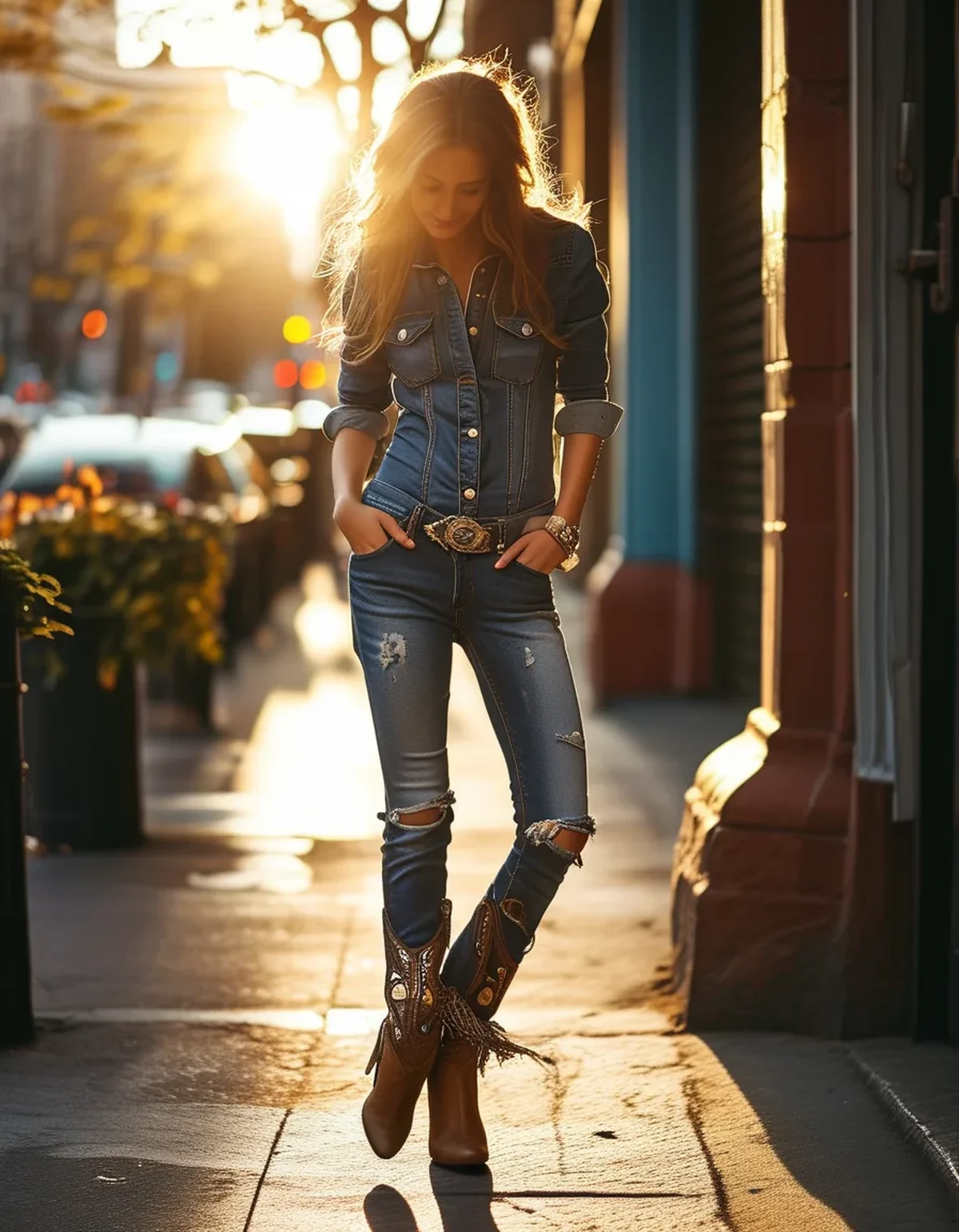
Shoes carry the most weight. Ankle boots, loafers, mules, and clean leather sneakers all support the jean reading. Running shoes immediately reclassify the whole outfit, no matter how good the leggings are. If you are wearing athletic shoes, you are wearing leggings and that is fine — just do not expect them to read as jeans.
Top length should hit where it would with jeans. With denim, tops often sit at or just below the waistband. Long tunic-length tops that cover the hips are a legging convention and will pull the whole outfit back toward athleisure regardless of the pant.
A front tuck or half-tuck is the fastest upgrade. It exposes the waistband, which sounds counterintuitive, but a visible structured waistband confirms the jean reading. It only works if the waistband is actually structured.
Add one woven piece to the outfit. A cotton shirt, a structured jacket, a leather belt. Woven fabric next to the leggings gives the eye a reference point, and the contrast helps rather than hurts.
Watch the fabric-weight match. Very thin, drapey tops beside a stretchy legging make the whole outfit read as loungewear. Some structure on top supports some structure on the bottom.
For layering into fall: a longer coat that hits below the knee works extremely well, because it hides the transition point and leaves only the ankle-to-shoe relationship visible — which, if you got the hem right, is your strongest angle.
FAQ: Denim-Look Legging Questions, Answered
Can you really not tell they are not jeans?
Up close, usually yes. At conversational distance with the right length, weight, and shoes, most people do not register it — and most people are not examining your pant fabric.
What length is most forgiving?
The ankle-bone crop. It works with the widest range of shoes, avoids ankle stacking entirely, and reads as a deliberate cropped jean rather than a legging that ran out of fabric.
Will hemming ruin the stretch?
Not if it is done with a stretch stitch — a coverstitch or twin needle. A standard straight stitch on a knit hem will break, so specify it when you drop them off.
How do I keep the color from fading?
Wash cold, inside out, no fabric softener, and line dry. Printed and dyed knits lose depth faster than indigo cotton, and heat is the main accelerant.
Are they appropriate for a casual office?
With a structured waistband, an ankle-length hem, loafers, and a woven top, they read close enough to a cropped jean that any workplace allowing jeans will not blink. In a business-casual environment where jeans are not allowed, they are not the workaround.
TL;DR: Hem length, not fabric, is what gives denim-look leggings away.
- Ankle-bone crop is the most reliable length — it works with nearly every shoe and never stacks.
- Full length only works on heavier, lower-stretch fabric. On thin fabric it always folds at the ankle and always reads athletic.
- Mid-calf lengths never work, regardless of print quality.
- Hemming is cheap and transformative — ask for a coverstitch or twin-needle stretch hem, not a straight stitch.
- Matte finish beats color accuracy, and contrast topstitching is the most convincing construction detail.
- Shoes and top length finish the illusion. Running shoes and tunic tops undo everything.
Stand ten feet from a mirror and look at your ankles. If there are folds there, that is the whole fix.
See It in Motion
Seen here: High Waist 8” Yoga Shorts — shop similar styles on bubblelime.com
Keep Reading
This article is for general informational and styling purposes only. Fit, sizing, and product availability may vary.