Why Denim Look Leggings Fade at the Knee First
Quick Answer: Denim-look leggings fade at the knee because that is where the fabric stretches most - typically 30 to 50 percent elongation every time you bend - and printed or coated denim finishes sit on top of the fibers rather than inside them. Stretched fabric spreads the print thinner, and repeated flexing plus friction abrades it. Real denim fades from indigo washing off the fiber surface; printed leggings fade from mechanical thinning and abrasion, which is why the fix is different too.
They looked perfect for two months. Now there are two pale ovals that follow your kneecaps around like headlights.

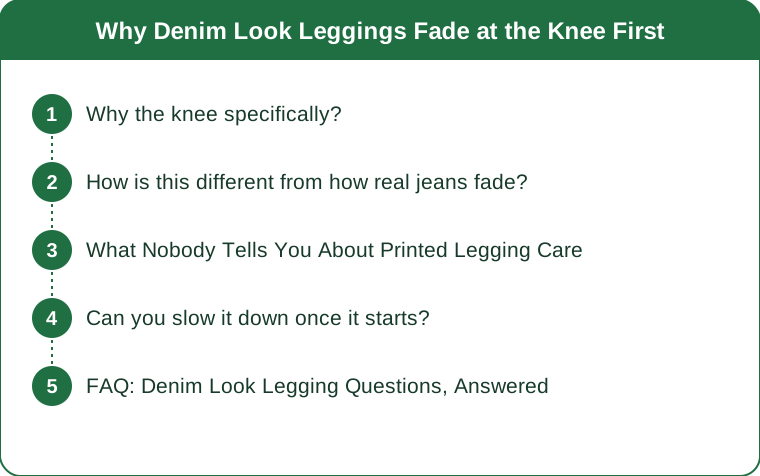
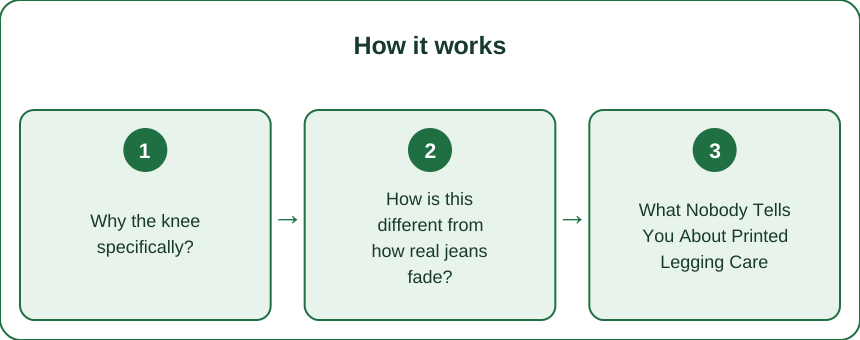
Why the knee specifically?
Because the knee is doing something no other part of the garment does.
Maximum stretch happens there. Sitting, squatting, or kneeling elongates the fabric over the kneecap far beyond anywhere else on the leg. Every bend spreads the printed layer over more surface area, and a print spread thinner looks lighter. Some of this recovers when you stand; over hundreds of cycles, some does not.
It is a friction zone. Knees brush against desks, car seats, each other while walking, and the floor whenever you kneel. Printed and coated surfaces abrade from the outside, and abrasion concentrates exactly where contact is highest.
Heat concentrates there too. The knee sits close to the skin surface with less soft tissue between fabric and joint, so it runs slightly warmer. Warmth plus stretch plus friction is the worst combination for a surface finish.
The print is a coating, not a dye. This is the core of it. Real denim is dyed indigo, which penetrates the outer fibers - fading reveals lighter fiber underneath, and people find that attractive. A denim-look legging carries a printed or transfer-applied pattern sitting on the fabric surface, so when it thins you do not get vintage character, you get a pale patch.
How is this different from how real jeans fade?
The visual result looks superficially similar and the mechanism is opposite, which explains why the same care habits do not transfer.
Jeans fade from the fiber outward. Indigo binds to the outside of the cotton fiber. Washing and wear remove dye layer by layer, revealing white core underneath - the celebrated whiskering and honeycombing of well-worn denim comes from this. The fade tracks where the fabric creases and rubs, and it is generally considered desirable.
Printed leggings fade from the surface in. The pattern is applied over a synthetic knit. Removing it leaves you seeing the base fabric color, which is usually a flat mid-blue or gray, and the transition looks patchy rather than gradated.
Recovery differs completely. Denim has minimal stretch and permanent creasing. Leggings with elastane recover most of their shape, but the printed layer does not recover with them - it has been physically spread and then relaxed, which cracks and thins it in a way the base fabric never shows.
Which means: the advice for real denim - wash rarely, wash cold, turn inside out - is only half-right for these. The washing advice transfers. The wear advice does not, because the damage is happening while you are wearing them, not in the machine.

What Nobody Tells You About Printed Legging Care
Heat is the fastest way to kill a print. A hot dryer is the single most damaging thing you can do - not because of the tumbling, but because heat softens the printed layer and the tumbling then abrades it while it is soft. Air drying alone can double the visible life of the print, more than any other single change.
Fabric softener actively degrades coated finishes. It leaves a residue that interferes with the bond between print and fabric and, on any performance base, ruins moisture management as well. Skip it entirely.
Inside out is genuinely worth doing. In the wash, the print then rubs against the fabric’s own interior rather than against zippers, other garments, and the drum. It takes three seconds and it works.
Kneeling is more damaging than squatting. Squats stretch the print. Kneeling stretches it and grinds it into a floor at the same time. If you garden, play with kids, or do any floor work, that is your primary wear source - not the gym.
Rotation matters more than technique. Two pairs alternated last more than twice as long as one pair worn daily, because the fabric gets recovery time between wears and elastane recovers better with rest. This is the highest-leverage habit and the least discussed.
Can you slow it down once it starts?
You cannot restore lost print, but you can substantially slow what remains - and you can choose better next time.
Change the wash routine immediately. Cold water, inside out, gentle cycle, no softener, air dry flat or hung. If the knee fade has just started, this alone typically buys several more months.
Stop the dryer entirely for these. Even a low tumble setting is meaningful abrasion. Hanging them takes a few hours in late-summer air.
Add a second pair to the rotation. Alternating is the cheapest life-extension available, and it also lets each pair recover its shape fully.
Reduce kneeling contact. If floor time is unavoidable, that is what your older pair is for. Assigning a designated floor pair is not fussy - it is just directing wear where you already accept it.
When buying, check how the pattern is applied. Look for terms indicating the pattern is knitted or woven in rather than printed on - a jacquard or yarn-dyed construction fades far more slowly because the color exists in the yarn. Heavier weights, generally 240 to 280 gsm, also resist thinning better than lightweight ones. A slightly matte finish hides early thinning better than a high-shine coated surface, which shows every stress point.
FAQ: Denim Look Legging Questions, Answered
Is knee fading a defect I can return?
Usually not after normal wear, since it is expected wear rather than a manufacturing fault. If it appears within a handful of wears, or if the print is cracking and flaking rather than thinning, that is worth raising with the retailer - premature print failure is a different thing from gradual fade.
Do darker denim-look leggings fade less noticeably?
They fade at the same rate but show it more, because the contrast between dark print and lighter base fabric is greater. Mid-blue and gray-blue washes hide early thinning best.
Will fading spread beyond the knee?
Usually the seat and the back of the thigh follow, for the same reasons - stretch plus chair friction. The knee simply gets there first because it combines both at maximum intensity.
Does turning them inside out to wear help?
No, and it defeats the purpose. Inside out is a washing measure only.
TL;DR:
- Knee fade is stretch plus friction thinning a surface print, not indigo washing off a fiber like real denim.
- The damage mostly happens while wearing and drying, not in the wash - heat is the single worst factor.
- Cold wash, inside out, no softener, no dryer, and rotate two pairs; rotation is the highest-leverage habit.
- When buying again, favor woven-in or jacquard patterns and heavier weights around 240 to 280 gsm over surface prints.
The frustrating part of this wear pattern is that it makes a perfectly functional legging look worn out long before the fabric is anywhere near finished. Once you know the print is a surface layer rather than a dye, the care routine stops being generic laundry advice and becomes a fairly short list of things that are genuinely worth doing.
See It in Motion
Seen here: High Waist Yoga Leggings with Inner Pocket — shop it on bubblelime.com
Keep Reading
This article is for general informational and styling purposes only. Fit, sizing, and product availability may vary.
